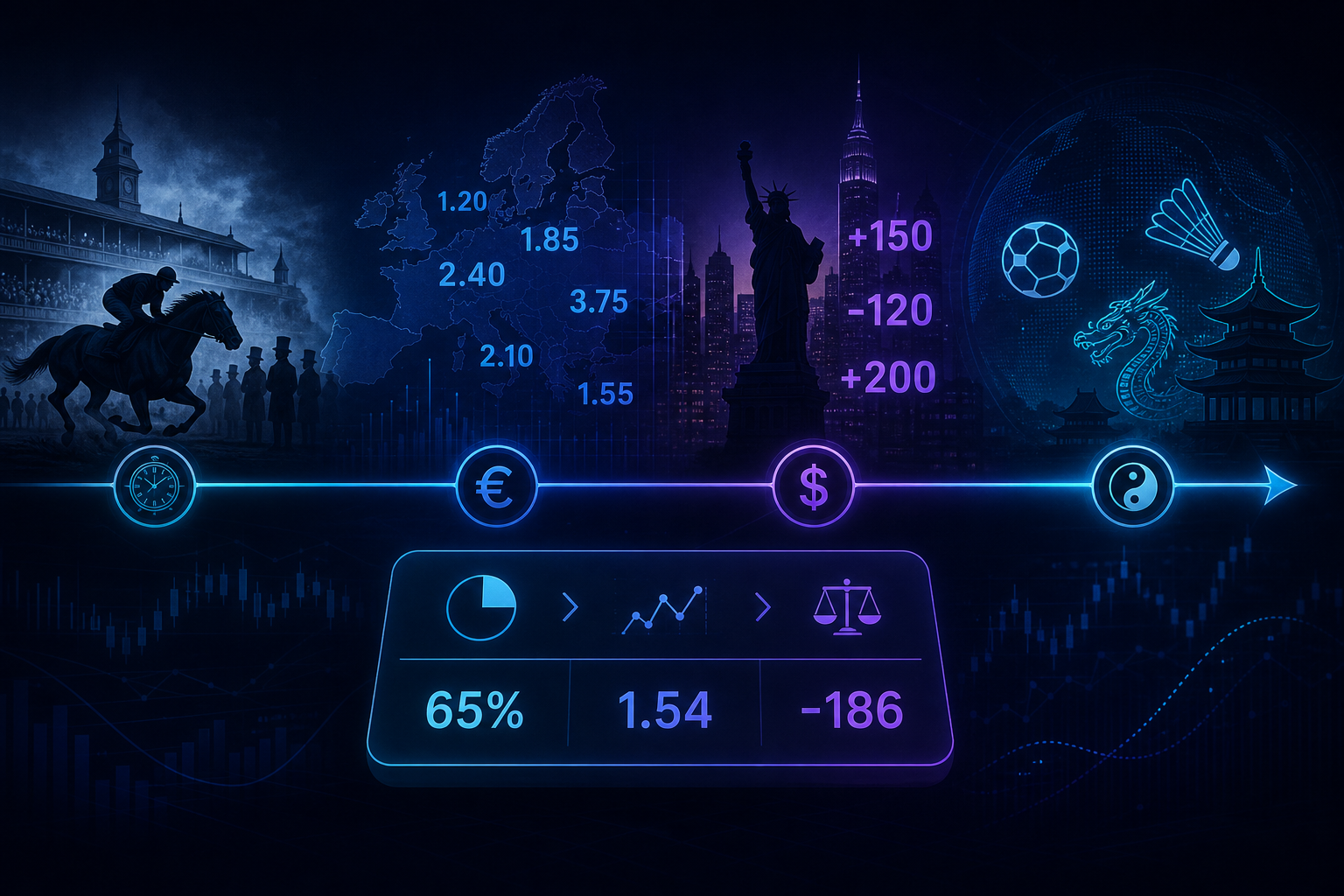
Polymarket odds formats: 8 ways to read the same probability, and their history
On Polymarket sports markets, the same price can display in 8 different formats depending on your habits. Each one tells the story of a time and region. Here's how to read them, convert between them, and why they exist.
El formato nativo de Polymarket (Price)
By default, Polymarket displays each contract as a price between $0.01 and $1.00. That price is the probability directly: a "Yes" contract at $0.65 means the market estimates a 65% chance the event happens. If it happens, the contract pays $1.00; otherwise, $0.
It's the most direct format, inherited from financial markets rather than traditional betting. See also displayed price = market-estimated probability.
Where to change format
This setting exists only on sports markets (NBA, NFL, MLB, football, tennis, MMA…). On non-sports markets (politics, crypto, economics, culture), only the default Price format is available.
To change format on a sports market: open the market, click the gear icon top right, then pick your format in the "Odds Format" menu. Your choice is remembered for future sports markets.
Si empiezas desde una zona con acceso restringido, consulta primero nuestra guía de acceso a Polymarket y VPN.
Changing display format does not change your actual position cost, potential profit, or fees. It's purely about readability.
Origins of each format
Price and Percentage are direct probability readings. The six formats below come from regional prediction-market traditions, same math, different display conventions.
Fractional, la más antigua (hipódromos ingleses)
Fractional odds (5/1, 2/7) are the oldest format still in wide use. They date to the 18th century, when the first bookmakers appeared in the UK for horse racing.
British currency itself was divided into fractions (shillings, pence), so thinking in ratios rather than decimals was natural. A bookmaker at the track would call out "5 to 1" or post it on a board, a tradition that persists in the UK and Ireland, especially in horse racing.
5/1 means for every £1 staked, you win £5 profit (plus your stake back). The format began declining in the 1990s with online betting, where decimal's simpler math appealed to a new generation.
Decimal, la respuesta continental
As betting spread from the UK to France and continental Europe, French and German bookmakers found British fractions too complex. Decimal odds were born from a desire to simplify: one number representing total return per unit staked, stake included.
It spread to Australia, Canada and Singapore, and remains the world's most used format on online betting platforms, no mental gymnastics required.
Decimal odds = 1 / probability
Example: 65% → decimal 1.54
American (moneyline), nacida en EE.UU.
American odds go far back in US betting history: first documented traces appear shortly after independence. The format took root in the local odds industry, then became the undisputed standard as Las Vegas rose as the world's prediction-market capital in the 20th century.
Unlike fractional and decimal formats that express total return, American odds highlight either required risk or potential profit, depending on whether the outcome is favorite or underdog. It fits American sports culture (football, basketball, baseball), where spotting favorite vs outsider quickly matters.
If probability > 50%: American = −(p / (1−p)) × 100
If probability < 50%: American = +((1−p) / p) × 100
Example: 65% → −186 (stake 186 to win 100)
Hong Kong, Malay, Indonesian (formatos asiáticos)
These three formats emerged in Asian betting markets, each with its own writing convention, but all mathematically close to decimal or fractional. Hong Kong format, for example, is essentially decimal minus 1, showing net profit rather than total return.
Quick conversion table
| Probability | Decimal | American |
|---|---|---|
| 80% | 1.25 | −400 |
| 65% | 1.54 | −186 |
| 50% | 2.00 | +100 |
| 35% | 2.86 | +186 |
| 20% | 5.00 | +400 |
Why this diversity still matters
These formats aren't arbitrary preferences: each carries the history of a region and era of betting. But comparing probabilities across platforms, or with traditional quoted probabilities elsewhere, requires converting everything to the same unit. Probability remains the only truly universal measure, regardless of original display format.
That's why in our communications, every trade shows both probability and equivalent decimal odds: to speak the same language as readers used to traditional odds while keeping prediction-market readability.
Want to follow our results for free? Sign up free by email for analysis and PDF alerts. Optional SMS.
Regístrate gratis por email para recibir análisis y PDF en cada predicción. Alerta SMS opcional.