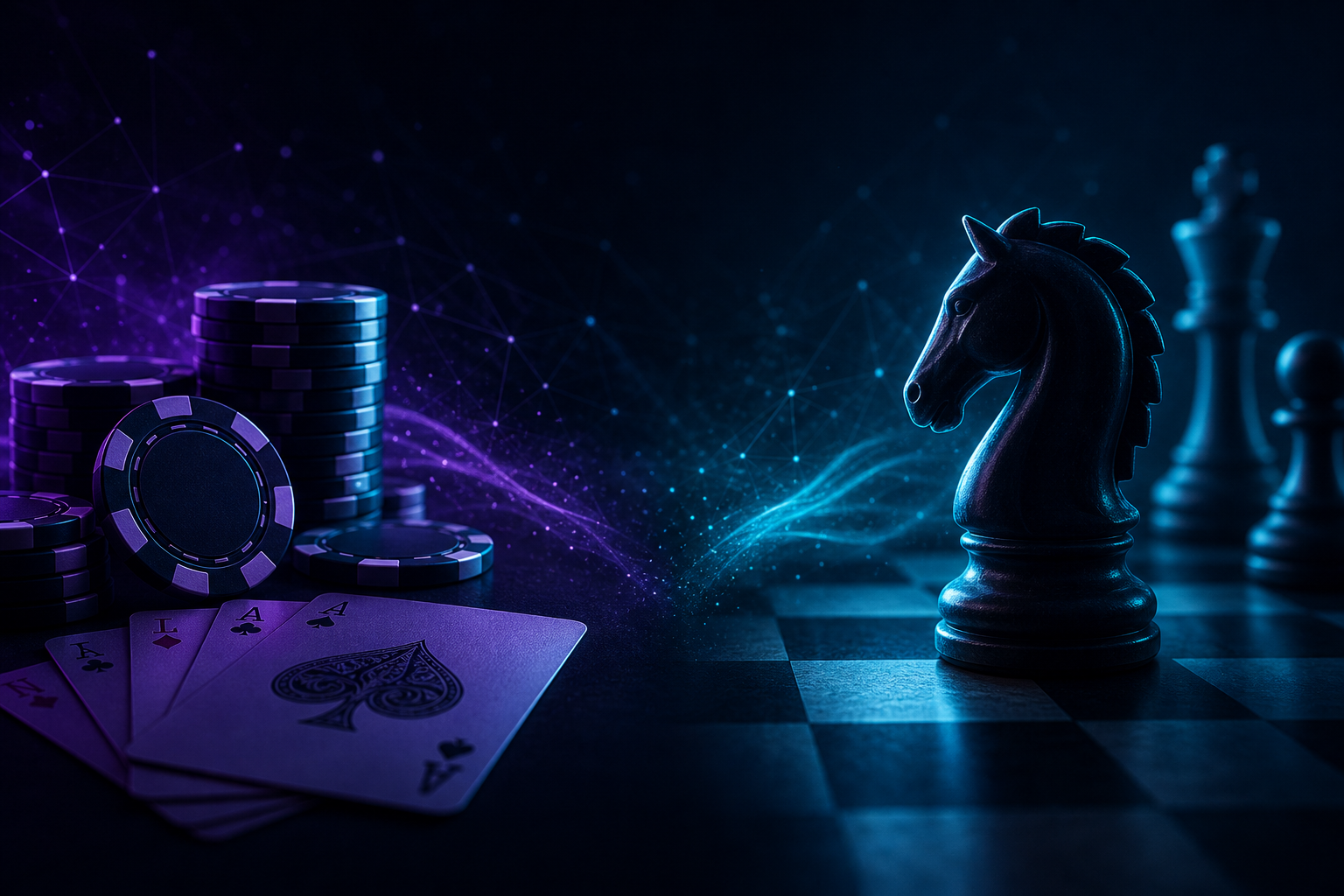
Life is more like poker than chess
Before becoming one of the world's leading decision scientists, Annie Duke won more than $4 million at the poker table. Here is what her bestseller teaches about deciding when the future is unclear.
Nothing in her background pointed to casinos. Annie Duke was pursuing a PhD in cognitive psychology at the University of Pennsylvania. Health problems and an urgent need for income pushed her to pause her studies and try poker. What was meant to be a short break lasted more than twenty years. The result: a world championship title, more than four million dollars in winnings, and legendary status in a hyper-masculine field.
In 2012 she left the cards behind and returned to psychology and decision science. In her landmark book Thinking in Bets, she distills what she learned watching the world's best players. A simple philosophy that directly feeds the PREDICT method.
1. A good decision can still end badly
In chess, everything is visible. No hidden cards, no dice. If you lose, the other player simply outplayed you.
Real life looks more like poker. You constantly decide without knowing all the variables, and luck shows up on every hand. You can make the perfect call and lose on a bad beat, or play like a fool and walk away rich on pure luck.
On 6 June 1944, Eisenhower went all in on D-Day despite dreadful weather, betting on a brief calm window forecast by his staff. The operation succeeded, and history calls it genius. But if the storm had intensified, troops would have drowned and he would have been dragged through the mud. Annie Duke calls this outcome bias: judging a decision only by how it ended, forgetting the fog at the start.
Evaluating decisions by their final result is the fastest way to learn the wrong lessons from both wins and losses.
2. Saying "I don't know" is not weakness
From school onward, we are taught that not knowing is a failure. Yet chasing absolute certainty in an unstable world is pure fantasy.
In the late 19th century, British Prime Minister Lord Salisbury forbade his diplomats from stating anything with certainty about neighboring countries' intentions. He required them to speak in probabilities (such as "6 chances out of 10"). Why? Because false certainty blocks you from pivoting when the unexpected arrives.
The best poker players and investors do not read the future in tea leaves. They assess confidence levels and probabilities. Accepting uncertainty keeps your mind open and lets you react quickly when the wind shifts.
What this changes at PREDICT
This logic runs through our daily process:
- Accept luck: A trade can rest on flawless analysis and still lose because of unforeseen news. That is not bad analysis. It is the probabilistic game.
- Write the inverse thesis before acting: To avoid rewriting history after the fact, we always draft an inverse thesis before investing. We put in writing what would invalidate our scenario. If those events occur, we exit immediately, without ego.
See also our Polymarket probabilities guide and BrainPredict origin story.
Sign up free by email to receive analysis and PDF with every prediction. Optional SMS alert.